Why Everyone Wants to Move on the Same Six Days of the Month
October 6, 2026
October 6, 2026
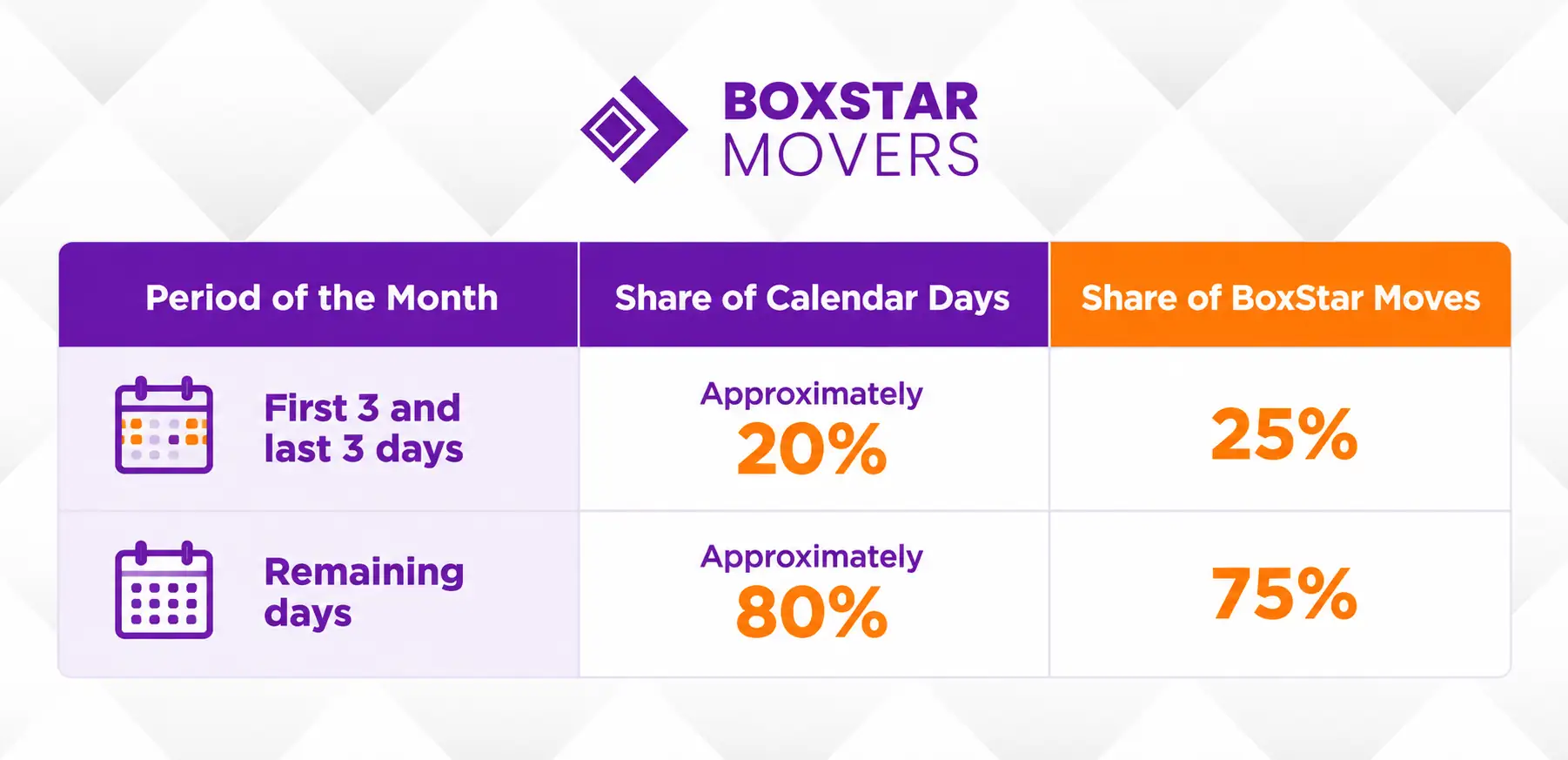
Across the 2,247 moves BoxStar Movers completed between September 2025 and September 2026, 25% fell in the first three or last three days of a month, days that make up about 20% of the calendar. The same beginning- and end-of-month concentration appears in BoxStar's 2024, 2025, and 2026 records.
That is a real pattern, though a modest one. Most moves still happen on the other 24 days or so, and the data describes BoxStar's own customers rather than every household in the region. This article looks at what the numbers show, why moving at the end of the month is so common, and what to weigh before choosing a date.
What Does BoxStar Movers' Data Reveal About Monthly Moving Patterns?
BoxStar's records show a consistent but moderate concentration of moves at the start and end of the month. Among the 2,247 moves completed between September 2025 and September 2026, one quarter landed on roughly one-fifth of the calendar days.
Six Days Account for a Quarter of Completed Moves
The first three and last three days of a month make up approximately 20% of calendar days, yet they account for 25% of BoxStar's moves. That works out to about 1.3 times the share expected if moves were spread evenly across every day.
The other 75% of moves happen throughout the rest of the month.
- Note: A lift of about 1.3 times is meaningful for planning, but it does not mean everyone moves at month end. Three out of four moves in this period happened on other dates.
The Pattern Appears Across Three Years of Moving Records
BoxStar found the same beginning- and end-of-month concentration in its 2024, 2025, and 2026 records. A pattern that repeats across years is more useful for planning than a single busy month, since it is less likely to be a one-time fluke. The comparison below uses approximate calendar-day shares and BoxStar's own completed jobs.
Why Do So Many Moves Happen at the Beginning or End of the Month?
Housing deadlines are the most plausible explanation, although BoxStar's booking data does not establish the cause. The reasons below are practical explanations that fit the pattern, not findings from the data itself.

Lease Expiration and Renewal Dates
Many rental agreements set a specific date for vacating, and that date often falls at the end of a month. This is a major reason moving at the end of the month is so common.
Tenants frequently schedule movers close to the final day of the lease, which leaves little room to shift the date if the preferred slot is taken. For many renters, moving at the end of the month is simply the date the lease allows.
- Tip: Check the lease for the exact move-out date, the time of day keys are due, and any cleaning or inspection requirements before booking movers.
New Lease Start Dates and Apartment Availability
A new lease start date controls when a tenant can actually enter the next home. Coordinating the move out of one property and into another gets harder when several practical details depend on a building's schedule:
- Building access hours on the first day of the lease
- Key pickup arrangements
- Management office hours and move-in paperwork
- Any inspection that must happen before moving in
Coordinating Closings, Possession Dates, and Other Housing Deadlines
Home purchases add their own deadlines, since a closing date and possession date can decide when a household is free to relocate. Lenders must deliver the Closing Disclosure at least three business days before closing, so paperwork timing is one of several reasons a closing date can shift.
A delayed closing or a change in property availability can move a moving date with little notice. Not every case of end-of-month moving is rental-related, and these homebuyer situations account for some of it.
What Challenges Can Come With Moving at the End of the Month?
End-of-month moving can mean less scheduling flexibility, because more households are working toward the same handful of dates. The challenges below are practical complications, not conclusions drawn from BoxStar's rates or crew capacity.

Limited Flexibility When Choosing a Moving Crew
When several customers request overlapping dates, the number of available options can narrow, so end-of-month moving may mean fewer choices of start time or a particular crew arrangement.
BoxStar's data does not show higher rates or a shortage of crews on these dates. It only shows that more moves cluster there.
- Tip: Across BoxStar's 2,247 moves between September 2025 and September 2026, the median gap between booking and moving day was 12 days, up from 7 days a year earlier. As practical advice, booking earlier than you used to have to is the simplest way to protect a preferred time.
The peak moving season guide covers the seasonal side of timing.
Tight Deadlines Between Moving Out and Moving In
Handing over one property while preparing to occupy another leaves little buffer. Moving at the end of the month makes a few problems more disruptive:
- Delayed access to the new home
- Packing that is not finished when the crew arrives
- Last-minute schedule changes
Limited time between leases means one unexpected delay can affect the whole sequence.
Apartment Building Rules and Shared Moving Facilities
Apartment buildings often add constraints that matter most when many residents move at once, which is typical of end-of-month moving. Common requirements include:
- Elevator reservations
- Loading areas or dock scheduling
- Move-in hours and building policies
- Insurance documents required from the moving company
Residents may need to share the same elevator or loading zone, so confirming building requirements before finalizing a date prevents surprises when moving at the end of the month.
This guide to moving with only street parking is useful when a building has no loading area.
Is Moving in the Middle of the Month a Better Alternative?
A mid-month move may offer more scheduling flexibility than moving at the end of the month, though BoxStar's data does not prove that any single date is best. The practical case for a date around the 10th rests on avoiding the first and last three days.

Why Moving Around the 10th May Offer More Flexibility
A date outside the first and last three days sits outside the concentration BoxStar observed. That may leave more room to choose a date and a start time.
The data compares those six days with all other days, so it does not establish the 10th as the least busy day of the month.
For the seasonal side, this overview of the best times of year to move in Washington, D.C. pairs well with the monthly view.
When a Mid-Month Move May Not Be Practical
Some households cannot choose. A mid-month date can be out of reach when:
- A lease has a fixed end date at the end of the month
- The new property is not available until the first
- Paying overlapping rent or mortgage costs outweighs the scheduling benefit
In those cases, deadlines come first. Short-term storage can sometimes bridge a gap, and this moving and storage service guide explains how to fold it into the plan.
How to Compare the Trade-Offs Before Choosing a Date
Comparing a few dates side by side makes the decision clearer. Useful points to evaluate include:
- The final day of the existing lease
- The earliest date the new property can be occupied
- Possible costs of overlapping leases or temporary storage
- Moving company availability on alternative dates
- Required elevator reservations, parking arrangements, or building approvals
What Should You Take Away From the Six-Day Moving Pattern?
Moving dates are often set by housing deadlines, and BoxStar's records show a measurable concentration around them: 25% of the 2,247 moves completed between September 2025 and September 2026 fell on the first or last three days of a month. They also show that most moves happen on other dates.
The most practical date balances housing obligations with enough flexibility to keep the relocation manageable. When the choice is open, looking beyond the first and last three days may be worthwhile.
When it is not, careful coordination matters more, and end-of-month moving goes best with early booking and clear building details.
Ready to Find a Date That Fits Your Lease?
If your dates are flexible, ask about mid-month availability when you request a quote. If they are fixed, booking early and confirming building access does most of the work for moving at the end of the month.
Get a free, no-obligation moving quote from BoxStar Movers and plan around your lease or closing date.