Appliance Moving Made Easy: Professional Tips and Tricks
According to the Household Appliance Injury Study, LendingTree, 2024, there were more than 150,000 household appliance-related emergency room visits in 2022, with refrigerators accounting for the largest share of injuries among all appliance categories.
Most of those injuries happen during everyday use. During a move, the risk is higher. Appliances are heavier than they look, more awkward than any piece of furniture, and more internally fragile than their exterior suggests. A standard refrigerator weighs between 200 and 400 pounds. Washing machines and dryers typically range from 150 to 300 pounds each. Moving any of these without the right preparation, tools, and technique is one of the most reliable ways to damage expensive equipment and injure the people carrying it.
This guide covers everything involved in appliance moving: how to prepare each type of appliance before the move, how to pack and protect them, and how to transport them safely from one home to another.
Why Does Appliance Moving Require More Care Than Other Household Items?
Appliances are not just heavy objects. They contain refrigerant systems, drum mechanisms, heating elements, electronic control boards, water lines, and compressors that are sensitive to tilting, impact, vibration, and temperature change.
Damage to these components isn't always visible on the outside. A refrigerator laid on its side during transport can have its compressor oil migrate into the refrigerant lines, causing failure when the unit is restarted. A washing machine moved without drum stabilizers can have its internal components shift in ways that only appear as a fault after the first wash cycle at the new address.
Beyond internal damage, improper handling can void manufacturer warranties and create liability for the mover. Understanding what each appliance needs before it goes on the truck is what separates a successful appliance move from an expensive repair call.
How to Prepare Appliances Before the Move
Preparation is the phase that most DIY movers rush or skip entirely. It is also the phase that determines whether appliances arrive in working condition.
Clean and Defrost Refrigerators and Freezers
Begin defrosting your refrigerator and freezer at least 24 to 48 hours before moving day. A refrigerator that hasn't been fully defrosted will leak water during transport, potentially damaging flooring, other items on the truck, and the appliance itself.
The preparation sequence for refrigerators and freezers:
- Empty all contents and remove shelves, drawers, and door bins.
- Turn off the unit and leave the doors open to allow complete defrosting.
- Wipe down all interior surfaces and allow them to dry completely.
- Store removable parts separately, wrapped and labeled.
- Tape the doors shut with stretch wrap or moving tape applied over a layer of cardboard to protect the door seal.
Do not restart the refrigerator for at least 2 to 4 hours after it arrives at the destination, and 24 hours if it was transported on its side, to allow compressor oil to settle back into position.
Disconnect and Drain Water-Using Appliances
Washing machines, dishwashers, and refrigerators with ice makers all have water connections that need to be properly disconnected before moving.
For washing machines:
- Turn off the water supply valves at the wall.
- Disconnect both inlet hoses and drain completely into a bucket.
- Run a short spin cycle to remove remaining water from the drum.
- Secure the drum with washing machine transit bolts (the same bolts used during original installation). If these have been discarded, consult the manufacturer's documentation for the correct stabilizer type.
- Tape or zip-tie the power cord to the back of the machine.
For dishwashers:
- Turn off the water supply and disconnect the supply line.
- Disconnect the drain hose and allow it to drain fully.
- Remove the bottom rack and dry the interior completely.
Secure Loose Parts and Doors
Before any appliance is moved, every door, drawer, rack, and removable component needs to be either removed and packed separately or secured so it cannot open during transport.
Use stretch wrap or moving straps to hold appliance doors closed. Apply a layer of cardboard or foam between the strap and the appliance finish to prevent scratches. Remove glass shelves, turntables, and drip pans from ovens and refrigerators, and pack them wrapped separately in packing paper or bubble wrap.
Protect Surfaces and Controls
Appliance surfaces scratch and dent under contact with other items during loading and transport. Digital control panels, stainless steel surfaces, and enamel finishes all require protection before the appliance goes near a door frame, truck ramp, or another piece of furniture.
Wrap the entire appliance in furniture blankets or moving pads. Secure the blankets with stretch wrap applied around the outside, not directly on the appliance surface. Pay particular attention to corners, control panels, and handles, which are the highest-impact points during loading.
How to Pack Appliances for Moving
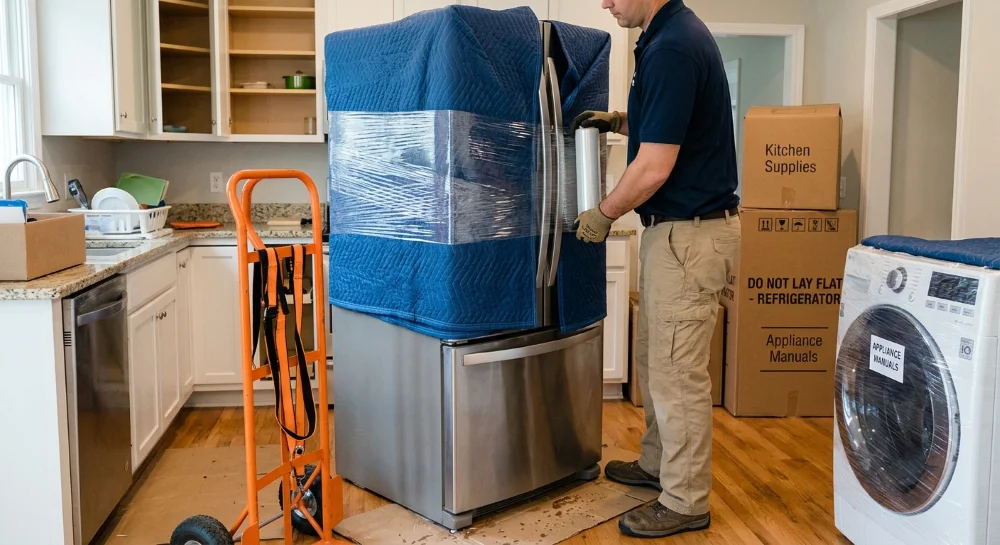
Should You Use Original Packaging or Moving Blankets?
Original manufacturer packaging is the best protection available for any appliance. It is engineered specifically for the item's dimensions, weight distribution, and fragile points, and it includes internal foam inserts designed to absorb impact.
If original packaging is not available, the following combination provides comparable protection:
- Heavy furniture blankets wrapped around the full appliance body
- Bubble wrap on control panels, glass surfaces, and protruding elements like handles
- Corner protectors on all four vertical edges
- Stretch wrap around the full assembly to hold blankets in place
- Clear labeling on orientation: "This Side Up" and "Fragile Controls" on the relevant faces
How to Label Appliances for Transport
Mark every appliance clearly before it goes on the truck:
- Indicate correct upright orientation with large arrows on all four sides
- Mark the side with fragile controls or glass components as "Fragile"
- Label the destination room to simplify unloading
- Attach any removed hardware, hoses, or accessories in a labeled bag taped to the back of the appliance
How to Use Appliance Dollies and Straps
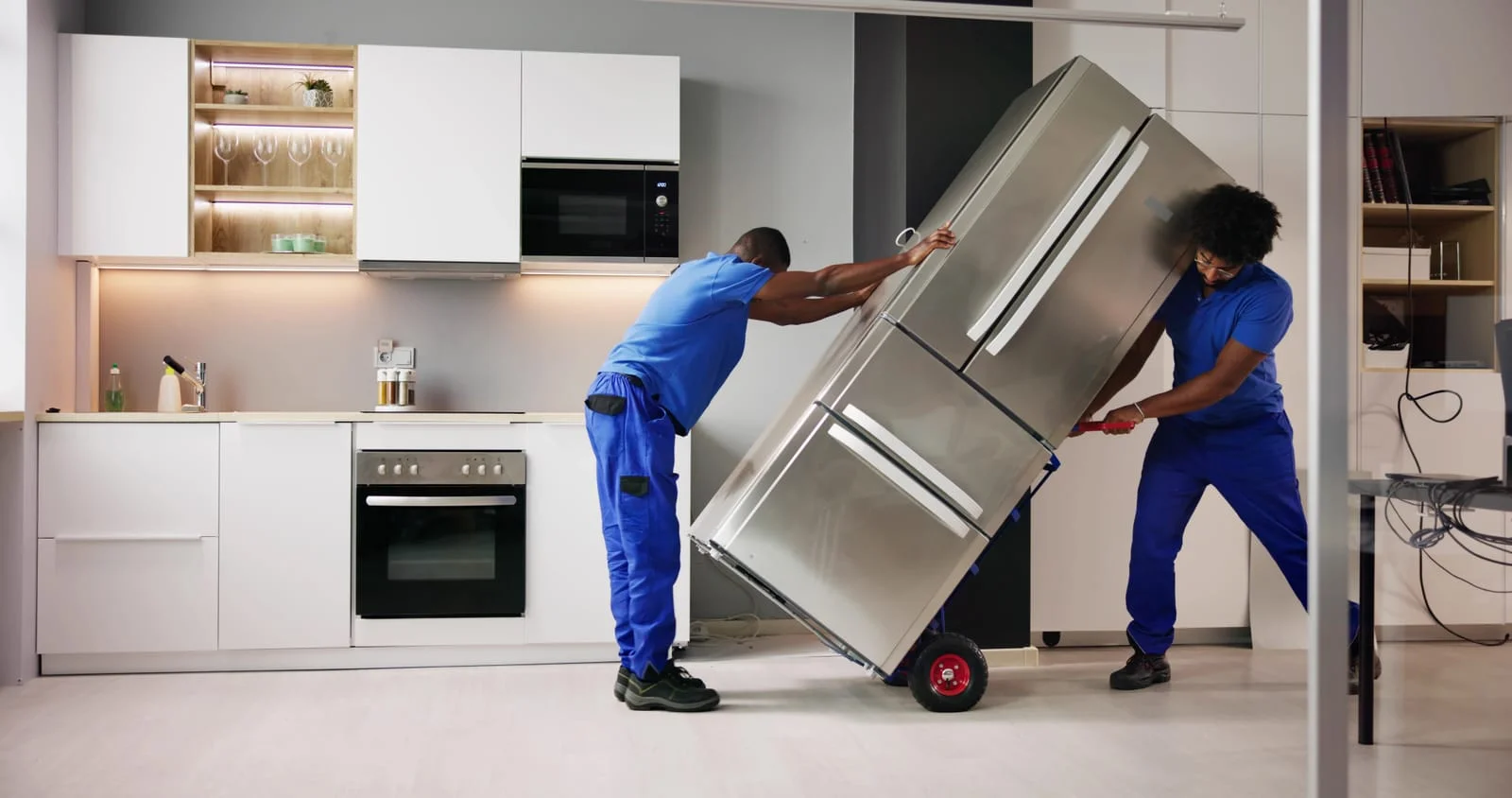
An appliance dolly is non-negotiable for any appliance over 100 pounds. A standard hand truck is not sufficient for refrigerators, washing machines, or large ovens. Appliance dollies are built with a taller back support, a wider base, and strap attachments rated for loads up to 700 pounds, and many include stair-climbing wheel configurations.
How to use an appliance dolly correctly:
- Tilt the appliance slightly and slide the dolly plate fully under the base.
- Secure the appliance to the dolly with the provided strap at its center of gravity, not at the top or bottom only.
- Tilt the dolly back to the transport angle and test stability before moving.
- For stairs, work with two people: one controlling the dolly from the back, one guiding from the front to prevent tipping.
- Move slowly and deliberately, especially around corners and through doorways.
Measure all doorways, hallways, and stairwells before moving day. A refrigerator that doesn't fit through a doorway with its handles attached can almost always fit with them removed, but only if you've identified this in advance.
What Are the Key Safety Tips for Moving Appliances?
The preparation and packing steps above reduce damage risk. These safety practices reduce injury risk.
- Never move a heavy appliance alone. A minimum of two people is required for anything over 75 pounds. For refrigerators and large washing machines, three people or professional movers is safer.
- Keep appliances upright throughout the move. Refrigerators and washing machines that are laid on their sides risk internal damage from component displacement and oil migration. If a refrigerator must be tilted to navigate a doorway, keep the tilt angle minimal and brief.
- Plan the route before you start moving. Walk the full path from the appliance's current location to the truck before you begin. Identify narrow points, steps, and obstacles and plan how to navigate each one.
- Use proper lifting technique. Bend at the knees, keep the back straight, and lift with the legs. Never lift with a rounded back or by bending at the waist. For sustained carries, take breaks before fatigue sets in rather than pushing through.
- Protect the floors. Lay ram board, cardboard, or appliance sliders along the move path before rolling or sliding anything. Appliance sliders under each corner allow heavy units to be guided across smooth floors without lifting.
For specialty or unusually heavy appliances, or for moves that involve stairs, narrow corridors, or long-distance transport, professional handling removes the injury and damage risk entirely.
BoxStar Movers provides specialist moving services with trained crews, appliance dollies, and the equipment needed to move heavy items safely across any distance. For long-distance appliance relocation, their long-distance moving services ensure appliances are properly secured throughout the journey.
Appliance Moving Comes Down to Preparation, Tools, and Patience
Most appliance moving damage happens in the first and last 10 minutes of the process: before proper preparation is complete, or when people rush the final loading step. The internal and external risks of appliance moving are both well understood and entirely preventable.
Defrost, drain, and secure every appliance before it moves. Wrap every surface before it leaves the room. Use an appliance dolly rated for the load. Keep everything upright. Move slowly. When the scale or complexity of the job exceeds what you can safely handle yourself, hire professionals who move appliances every day. The cost of a professional crew is a fraction of the cost of a damaged compressor, a cracked floor, or a back injury.
Moving appliances as part of a relocation?
BoxStar Movers handles heavy, delicate, and specialty items with trained crews and the right equipment.
Get your transparent, no-hidden-fees quote today.
Frequently Asked Questions
How do I protect wood floors when moving appliances?
Lay ram board, heavy cardboard, or dedicated floor protection sheets along the full move path before rolling or sliding anything. Place appliance sliders under each corner of the unit to allow it to glide across hardwood or tile without scratching. Never drag an appliance on bare flooring, even for short distances. Check all four slider positions before moving.
Should I use original appliance boxes, or are moving blankets sufficient?
Original packaging is the best option when available, as it is engineered for the appliance's specific dimensions and fragile points. When original boxes are not available, heavy furniture blankets combined with bubble wrap on control panels and corner protectors on edges provide comparable protection for most appliances. Secure everything with stretch wrap applied over the blankets, not directly on the appliance surface.
How do I prevent scratches and dents while moving large appliances?
Wrap the entire appliance in furniture blankets before it contacts any door frame, ramp, or truck wall. Apply cardboard or foam padding between the appliance and any strap used to secure it. Pay extra attention to stainless steel surfaces and control panels, which show contact marks easily. Move slowly through doorways and keep a second person guiding to prevent contact with frame edges.
What tools are essential for moving heavy appliances safely?
An appliance dolly rated for the load weight is the most important tool. Add moving straps for securing the appliance to the dolly, furniture blankets for surface protection, stretch wrap to hold blankets in place, appliance sliders for floor protection, and transit bolts for washing machines. A measuring tape to confirm doorway and hallway clearances before moving day prevents the most common logistical problem.
When is it worth hiring professionals instead of moving appliances yourself?
Hire professionals when the move involves stairs, very narrow corridors, or more than one large appliance. Also consider professional help if any appliance requires gas disconnection, if the destination is long-distance, or if you don't have access to an appliance dolly and a minimum of two capable helpers. The cost of a professional appliance move is typically far less than the repair or replacement cost of a damaged unit, or the medical cost of a handling injury.