5 Expert Tips for Successful Long-Distance Piano Moving
Pianos have over 10,000 moving parts, which makes them one of the most mechanically complex and physically demanding items to transport safely over any distance.
That complexity is the core challenge of long-distance piano moving. A piano isn't just heavy. Upright models weigh between 200 and 1,000 pounds, and grand pianos can exceed 1,200 pounds. It is also structurally sensitive in ways that standard moving equipment simply isn't designed to handle. Strings under extreme tension, a cast-iron plate that accounts for up to 70% of the instrument's weight, a delicate soundboard, and thousands of internal components all need to survive hundreds of miles of road vibration, temperature shifts, and loading transitions.
This guide covers 5 expert tips for how to move a piano long distance without damage, from custom crating through insurance coverage.
Why Moving a Piano Long Distance Requires Special Attention
A standard moving crew with standard equipment is not equipped for long-distance piano moving. The risks aren't theoretical: a piano shifted during transit can crack its soundboard, damage its action mechanism, or break the bridge that transfers string vibration to the body. Any of these outcomes means a repair bill that can rival the instrument's value, or an irreplaceable loss if the piano is a vintage or heirloom instrument.
Three factors make pianos uniquely demanding on a long-distance move.
- First, their weight and irregular shape make loading and securing genuinely hazardous without specialized equipment.
- Second, their internal mechanics are sensitive to vibration, humidity changes, and temperature swings that a multi-day road journey will inevitably produce.
- Third, moving a grand piano long distance requires partial disassembly: legs, lyre, and lid must be removed, which introduces additional handling risk at both ends of the move.
How to Protect Your Piano Before and During the Move
Getting the preparation right before the truck is loaded determines how the piano arrives. These first two tips cover the physical protection side of long-distance piano moving.
Tip 1: Invest in Custom Piano Crating for Long-Distance Moves
Custom crating is the single most effective protection measure for long-distance piano transport. A custom crate is built to the exact dimensions of your specific piano, its length, width, height, and profile, rather than being a generic box your instrument happens to fit inside.
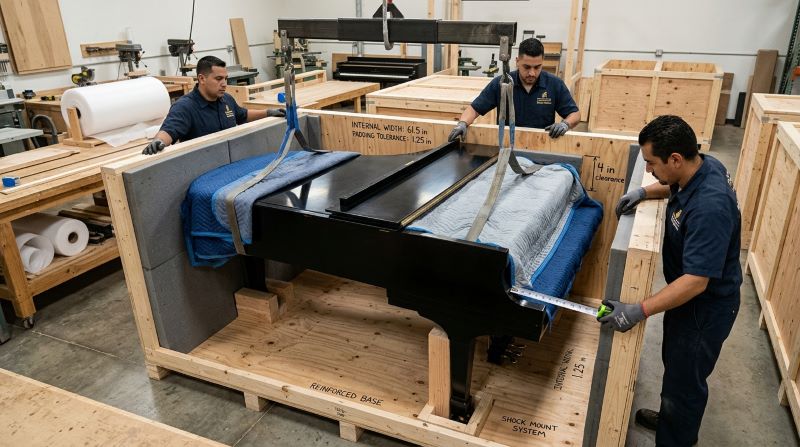
The difference matters because pianos don't distribute weight evenly or sit flat. A custom crate accounts for the instrument's actual shape, reinforces the points that bear load during transport, and immobilizes the piano so it cannot shift inside the crate regardless of road conditions.
For moving a grand piano long distance, custom crating is particularly important because the instrument travels on its side, increasing its vulnerability to impact and pressure without proper internal support.
Ask your mover directly whether they build or source custom crates for your piano type. A professional piano mover should be able to confirm this without hesitation.
Tip 2: Use Proper Packaging and Protective Materials
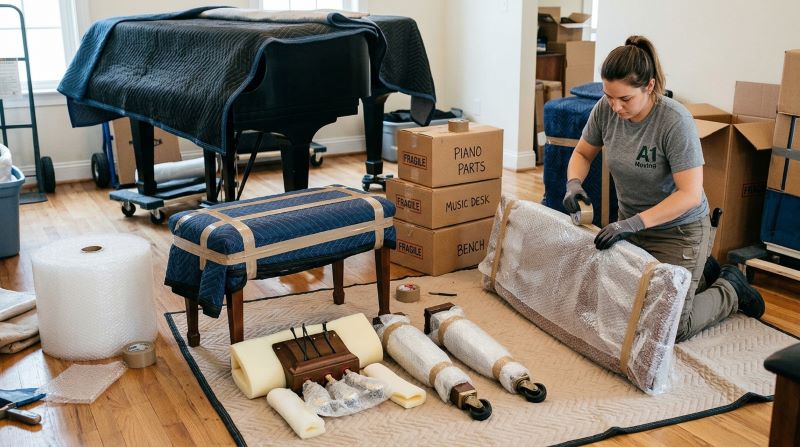
Custom crating protects the instrument structurally. Protective wrapping protects its exterior and most vulnerable components during the loading, transit, and unloading process.
The correct layering for a piano looks like this:
- Wrap the entire exterior in heavy moving blankets, secured with stretch wrap or banding (not tape directly on the finish)
- Pad the keyboard lid separately, as it is a high-impact risk during loading
- Secure the fallboard (the cover over the keys) closed before wrapping to prevent the keys from shifting or being struck
- Remove and individually wrap the music desk, bench, and any detachable exterior panels
- For grand pianos, wrap each leg separately after removal, padding the corners and any curved sections
Never apply tape directly to a piano's lacquered finish. Adhesive residue and peel damage on high-quality lacquer can be costly and sometimes irreversible.
How to Secure and Transport a Piano Safely Over Long Distances
Protection on the ground means little if the piano isn't properly secured in the truck. These two tips address the best way to move a piano long distance, which extends through the transport itself.
Tip 3: Secure the Piano Properly During Transport
A piano that isn't firmly anchored will shift during transit, regardless of how well it's wrapped. On a long-distance move, even minor shifting accumulates: each braking event, road bump, and turn adds stress to the instrument.
Professional piano movers use a combination of specialized equipment to prevent this:
- Heavy-duty tie-down straps rated for the piano's specific weight
- A purpose-built piano board or skid that locks the instrument's base position
- Furniture pads and blocking between the piano and truck walls
- Air-ride suspension vehicles, which absorb road vibration more effectively than standard moving trucks
Verify with your mover that their truck has air-ride suspension for a safe piano move. It is not a luxury on a multi-day haul. It is a meaningful difference in the level of vibration the instrument absorbs over hundreds of miles.
Tip 4: Plan for the Special Conditions of Long-Distance Moves
Road transport over long distances exposes a piano to environmental conditions that a local move simply doesn't produce. Temperature fluctuations, humidity changes, and extended vibration all affect the instrument in ways that result in tuning problems, finish cracking, or, in serious cases, structural damage.
Plan your move dates with these conditions in mind. Extreme summer heat and winter cold are both hard on pianos. If you have flexibility, moving in the spring or fall reduces environmental risk significantly. And regardless of season, never play your piano immediately after delivery. Allow it to acclimate to its new environment for at least 24 hours before use, and schedule a tuning one to two weeks after arrival.
How to Protect Your Investment With the Right Insurance
Professional handling reduces risk dramatically. It doesn't eliminate it. For an instrument that can be worth tens of thousands of dollars, understanding your coverage before anything moves is non-negotiable.
Tip 5: Understand the Insurance and Liability for Your Piano
Most standard moving insurance covers belongings at a rate of $0.60 per pound under basic released value protection. For a 700-pound baby grand, that's $420, a small fraction of its actual value. Do not assume basic coverage is sufficient for a piano.
Full value protection is the appropriate coverage for a long-distance piano move. Under this option, the mover is liable for repair, replacement, or reimbursement at the item's current market value if damage occurs. Before you sign, verify the following:
- Whether the mover offers full value protection specifically for musical instruments
- What the claims process looks like and what documentation is required
- Whether pre-existing condition exclusions apply and how they are assessed
- What the deductible is, if any, under full value protection
It is also worth checking your homeowner's or renter's insurance policy. Some policies extend coverage to high-value personal property during a move. If yours does, confirm the coverage limit and whether a transit rider is needed for items over a certain value.
BoxStar Movers provides dedicated piano moving services with trained crews and the appropriate equipment for both upright and grand piano transport. For a full picture of what a professional long-distance move looks like from start to finish, the BoxStar long-distance moving service covers all the logistics around your piano move.

What Successful Long-Distance Piano Moving Actually Comes Down To
The 5 tips above cover the full arc of moving a piano long distance: custom crating for structural protection, correct wrapping for the exterior, proper tie-down and suspension for transit, environmental planning for the journey, and insurance that reflects the instrument's actual value.
Every one of these steps depends on working with movers who have specific piano experience, not just general moving credentials. Ask about crating, ask about air-ride suspension, ask about full value protection. If a mover can't answer those questions clearly, that's your answer.
For an instrument with thousands of components and potentially significant monetary and sentimental value, the best way to move a piano long distance is to choose specialists and verify the details before anything is loaded.
BoxStar Movers offers specialist piano moving with trained crews, proper equipment, and transparent pricing. Get a free quote today.
Frequently Asked Questions
How do I pack a piano for moving?
Wrap the full exterior in heavy moving blankets secured with stretch wrap; never tape directly on the finish. Secure the keyboard lid and fallboard closed, remove and individually wrap detachable parts, and use custom crating for long-distance transport. A professional piano mover handles this process with purpose-built equipment.
What type of moving truck is best for transporting a piano long distance?
A truck with air-ride suspension is the best option for long-distance piano moving. Air-ride systems absorb road vibration significantly better than standard truck suspension, reducing the cumulative stress on the piano's action mechanism and finish over a multi-day haul.
Are there risks to the piano during the move I should be aware of?
Yes. The main risks are physical damage from shifting or impact during transit, tuning instability from vibration and temperature changes, finish damage from improper wrapping, and humidity-related swelling or cracking. All are reduced significantly by professional handling, proper crating, and a climate-aware transport plan.
Is it necessary to disassemble a piano for long-distance moves?
For upright pianos, partial disassembly is usually limited to removing the lid and music desk. For moving a grand piano long distance, the legs, lyre assembly, and lid must be removed before the instrument can be safely positioned on its side for transport. Reassembly at delivery requires the same trained crew.
Should I insure my piano for a long-distance move, and what's the best coverage?
Yes. Basic released value protection at $0.60 per pound is not adequate for most pianos. Full value protection through your mover is the appropriate minimum, covering repair or replacement at current market value. Also, check your homeowner's or renter's policy for transit coverage on high-value items.